UX Writing
Improving Employee Survey Completion
Compnay:
ServiceNow
Intro: ServiceNow builds enterprise workflow tools used across IT, HR, and employee operations.
Problem :
The People Tech team relied on an employee satisfaction survey to inform roadmap and prioritization decisions. Despite being live for weeks, the survey saw very low completion rates.
Employees consistently opened the survey, began answering questions, and then dropped off before finishing, indicating interest, but high friction.
Goal :
Increase survey completion by reducing friction while maintaining the quality of employee feedback.
Diagnosis :
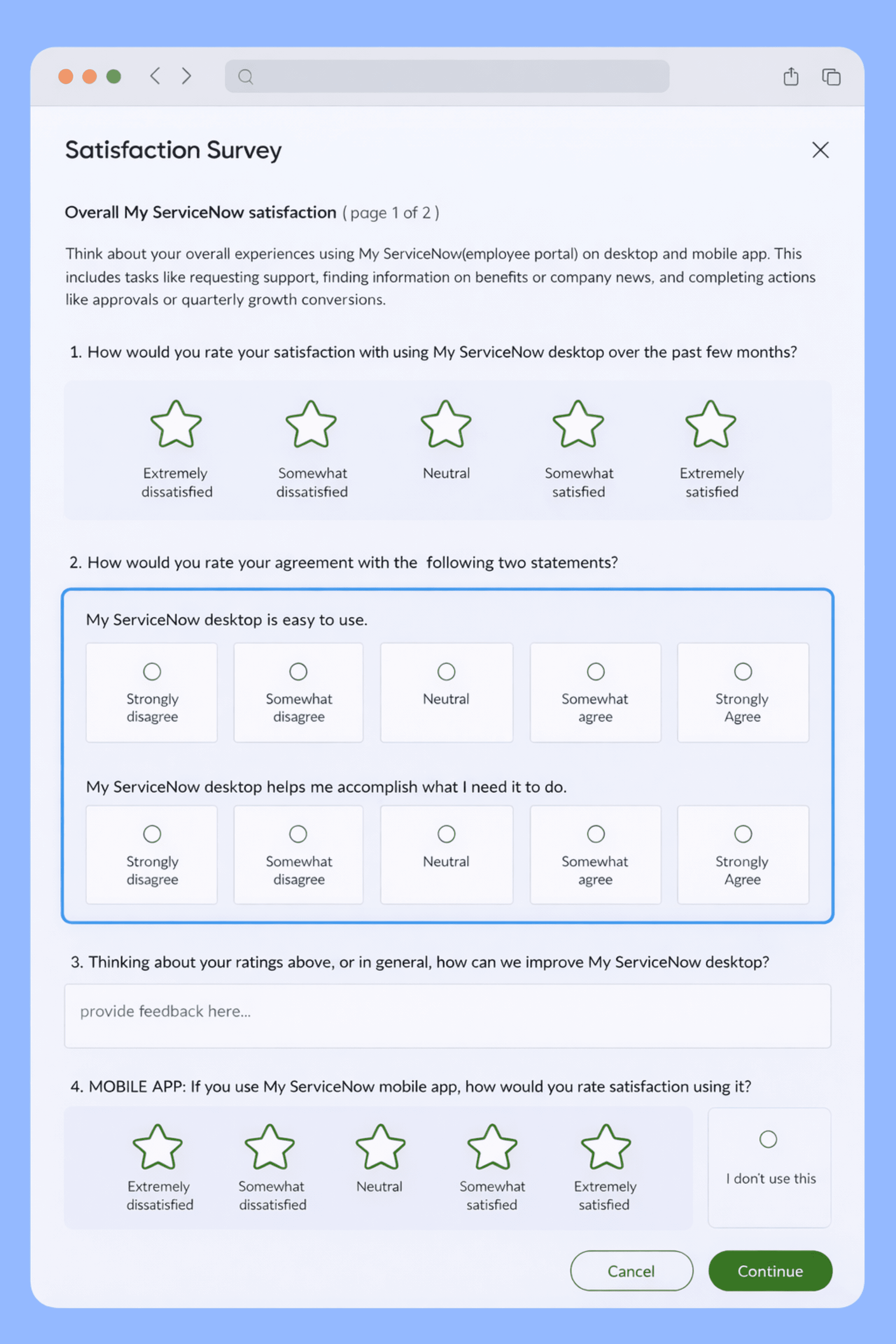
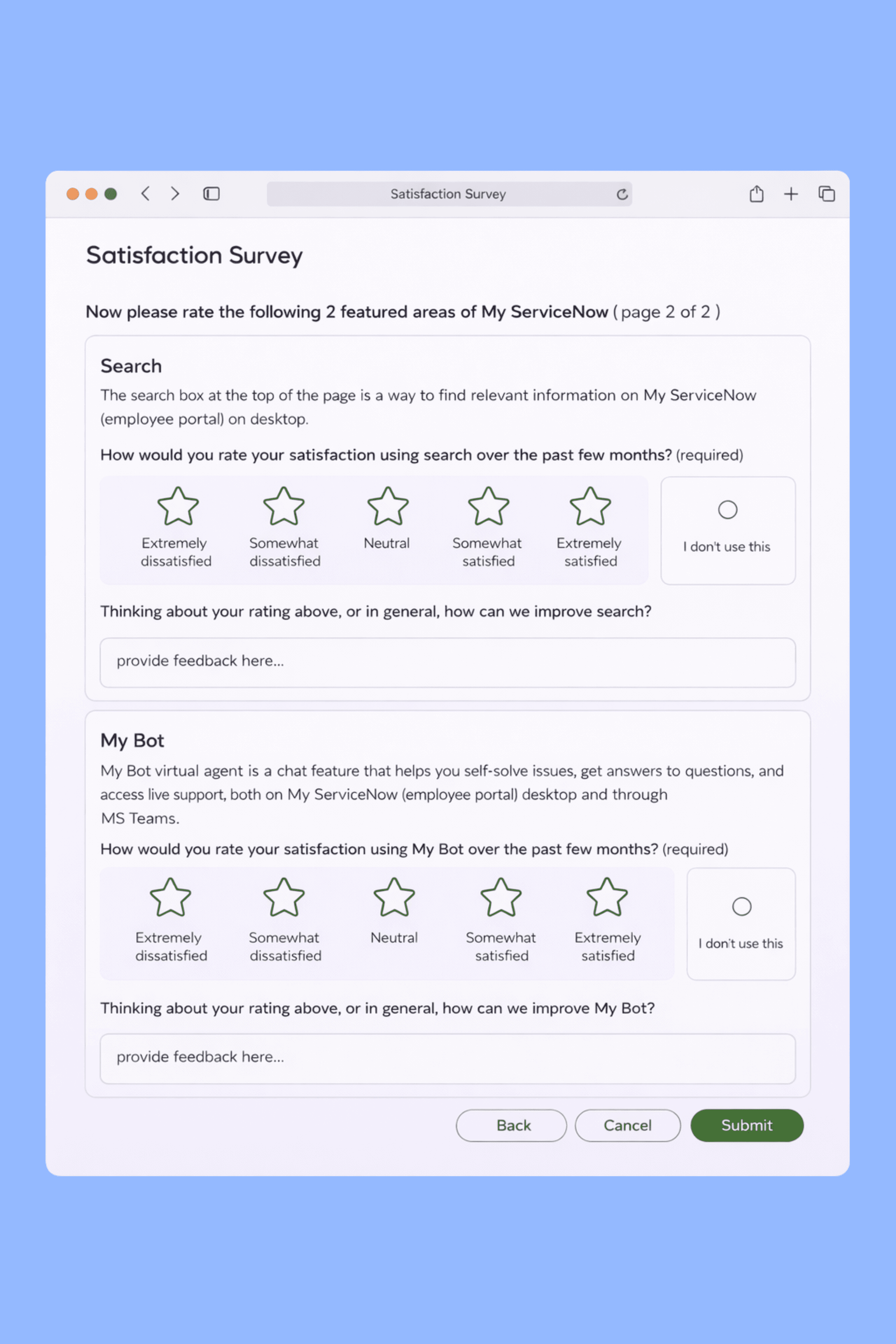
A content and UX audit revealed several systemic issues contributing to drop-off
This included:
too many required questions
forced open-ended responses early in the flow
inconsistent answer formats
mixed writing cadence
a multi-page layout for a short task
Together, these created cognitive load and made the survey feel heavier than it needed to be. You can view the Initial Survey Design below.
Hypothesis :
If the survey followed content and UX best practices, and felt fast to complete, employees would be more likely to finish it.
Timeline :
1 design sprint
Solution :
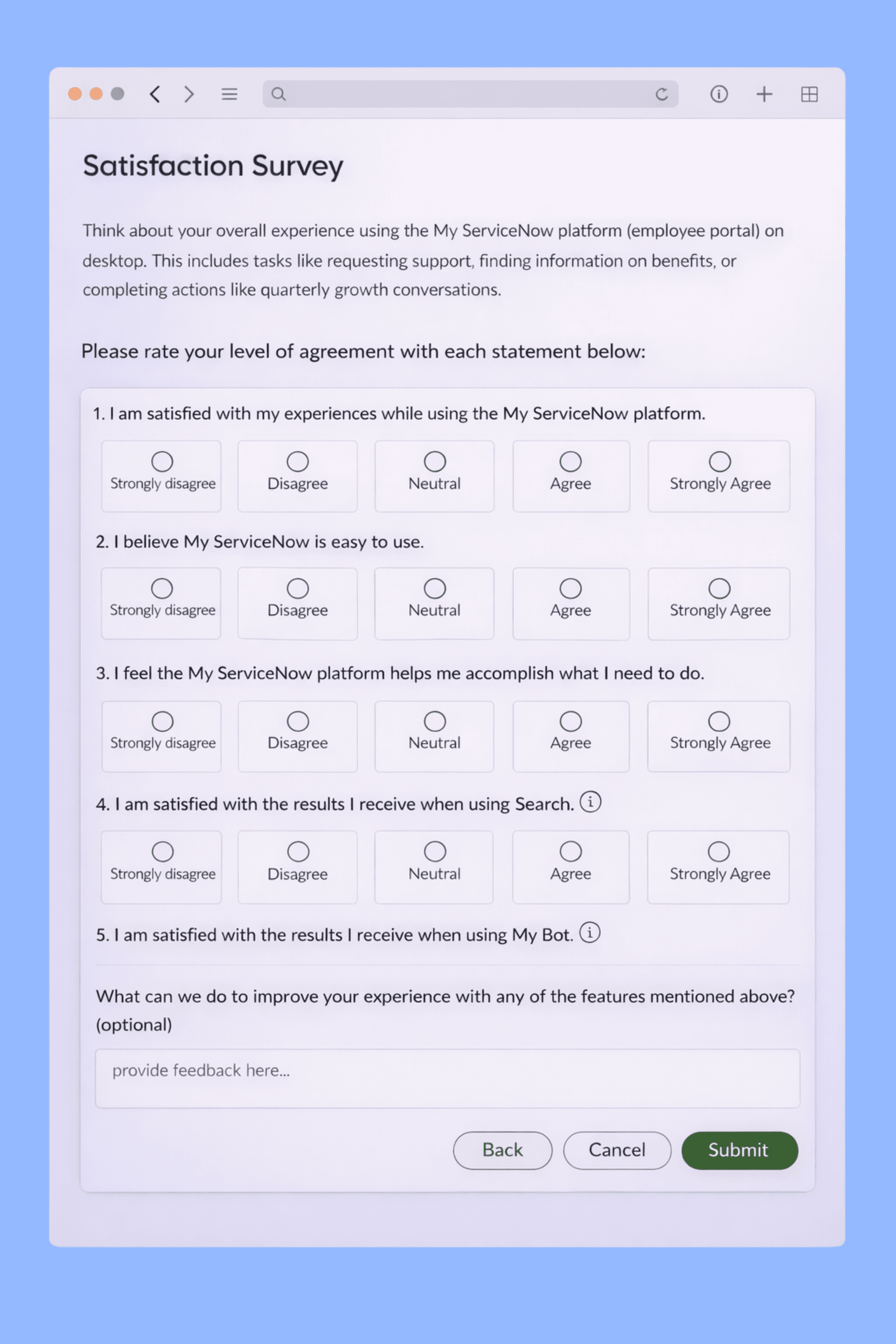
I proposed and delivered a content and structural overhaul:
This included:
standardized question cadence and tone
aligned all questions to a single answer format
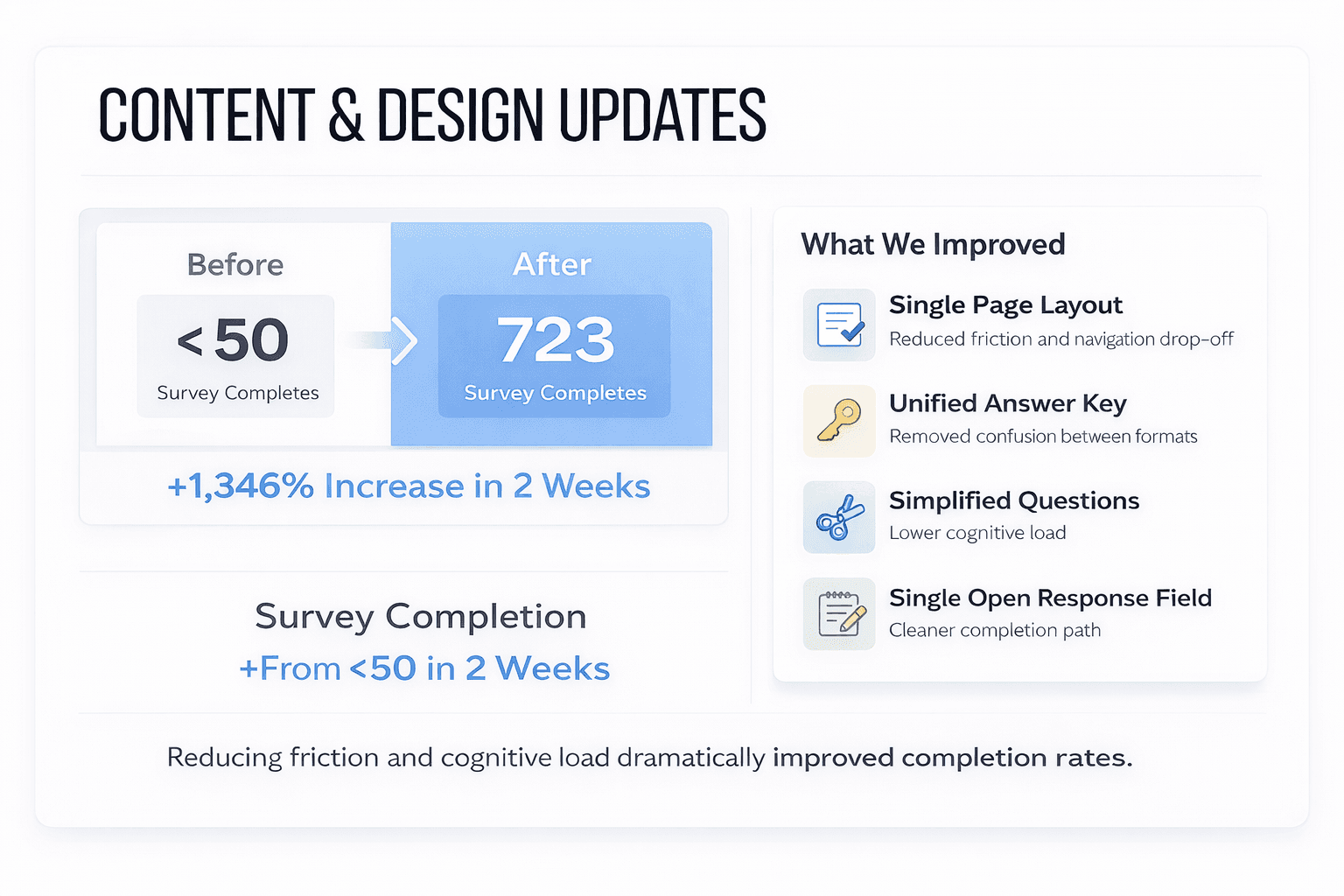
consolidated open-ended feedback into one optional question at the end
reduced the survey from six questions to five
redesigned the layout to fit on a single page
Partners :
I partnered with a UX Researcher to review drop-off data, validate friction points, and present two redesign options to stakeholders with clear tradeoffs.
Testing :
Once a design was chosen and approved, the survey was deployed as a persistent tab and pullout drawer across the internal employee site. The redesigned survey ran for two weeks.
Outcome :
Survey completion increased from 50 total responses over several months to 723 completed responses in two weeks.
Impact:
Beyond the immediate lift in completion, this work established a repeatable survey model:
documented content and UX best practices
a shared framework for balancing depth and completion
guidelines adopted by the survey team for future surveys
As a next step, the survey guidelines were incorporated into the ServiceNow UX Content Style Guide, scaling the impact beyond a single project.

More Projects





UX Writing
Improving Employee Survey Completion
Compnay:
ServiceNow
Intro: ServiceNow builds enterprise workflow tools used across IT, HR, and employee operations.
Problem :
The People Tech team relied on an employee satisfaction survey to inform roadmap and prioritization decisions. Despite being live for weeks, the survey saw very low completion rates.
Employees consistently opened the survey, began answering questions, and then dropped off before finishing, indicating interest, but high friction.
Goal :
Increase survey completion by reducing friction while maintaining the quality of employee feedback.
Diagnosis :
A content and UX audit revealed several systemic issues contributing to drop-off
This included:
too many required questions
forced open-ended responses early in the flow
inconsistent answer formats
mixed writing cadence
a multi-page layout for a short task
Together, these created cognitive load and made the survey feel heavier than it needed to be. You can view the Initial Survey Design below.
Hypothesis :
If the survey followed content and UX best practices, and felt fast to complete, employees would be more likely to finish it.
Timeline :
1 design sprint
Solution :
I proposed and delivered a content and structural overhaul:
This included:
standardized question cadence and tone
aligned all questions to a single answer format
consolidated open-ended feedback into one optional question at the end
reduced the survey from six questions to five
redesigned the layout to fit on a single page
Partners :
I partnered with a UX Researcher to review drop-off data, validate friction points, and present two redesign options to stakeholders with clear tradeoffs.
Testing :
Once a design was chosen and approved, the survey was deployed as a persistent tab and pullout drawer across the internal employee site. The redesigned survey ran for two weeks.
Outcome :
Survey completion increased from 50 total responses over several months to 723 completed responses in two weeks.
Impact:
Beyond the immediate lift in completion, this work established a repeatable survey model:
documented content and UX best practices
a shared framework for balancing depth and completion
guidelines adopted by the survey team for future surveys
As a next step, the survey guidelines were incorporated into the ServiceNow UX Content Style Guide, scaling the impact beyond a single project.
More Projects
UX Writing
Improving Employee Survey Completion
Compnay:
ServiceNow
Intro: ServiceNow builds enterprise workflow tools used across IT, HR, and employee operations.
Problem :
The People Tech team relied on an employee satisfaction survey to inform roadmap and prioritization decisions. Despite being live for weeks, the survey saw very low completion rates.
Employees consistently opened the survey, began answering questions, and then dropped off before finishing, indicating interest, but high friction.
Goal :
Increase survey completion by reducing friction while maintaining the quality of employee feedback.
Diagnosis :
A content and UX audit revealed several systemic issues contributing to drop-off
This included:
too many required questions
forced open-ended responses early in the flow
inconsistent answer formats
mixed writing cadence
a multi-page layout for a short task
Together, these created cognitive load and made the survey feel heavier than it needed to be. You can view the Initial Survey Design below.
Hypothesis :
If the survey followed content and UX best practices, and felt fast to complete, employees would be more likely to finish it.
Timeline :
1 design sprint
Solution :
I proposed and delivered a content and structural overhaul:
This included:
standardized question cadence and tone
aligned all questions to a single answer format
consolidated open-ended feedback into one optional question at the end
reduced the survey from six questions to five
redesigned the layout to fit on a single page
Partners :
I partnered with a UX Researcher to review drop-off data, validate friction points, and present two redesign options to stakeholders with clear tradeoffs.
Testing :
Once a design was chosen and approved, the survey was deployed as a persistent tab and pullout drawer across the internal employee site. The redesigned survey ran for two weeks.
Outcome :
Survey completion increased from 50 total responses over several months to 723 completed responses in two weeks.
Impact:
Beyond the immediate lift in completion, this work established a repeatable survey model:
documented content and UX best practices
a shared framework for balancing depth and completion
guidelines adopted by the survey team for future surveys
As a next step, the survey guidelines were incorporated into the ServiceNow UX Content Style Guide, scaling the impact beyond a single project.