Content strategy
Content Systems Thinking
Scope:
Sales Enablement CRM Platform
Compnay:
Timeline:
2 months
Intro:The Google Sales Enablement CRM Platform is an internal product that supports Google’s ad sellers teams responsible for driving the majority of Google’s revenue. The platform is highly complex and continuously evolving, with new workflows, data models, and AI-powered tools being introduced alongside long-standing legacy systems.

Problem :
The platform relied heavily on “Insights” to deliver value to sellers—yet the term had no shared definition.
Over time:
“Insight” became an umbrella label for any type of information
20+ teams shipped insights independently, without coordination
Sellers received 50–100 insights per day, regardless of relevance
Critical signals were buried in noise
CSAT data showed sellers perceived insight quality as low
One undefined term was undermining usability, prioritization, and adoption across the platform.
Goal :
Fix the problem by turning “Insights” into a clear, scalable system:
Establish a single definition
Categorize insights by purpose and importance
Align teams on when and how insights should appear
Reduce cognitive load while increasing actionability
Approach :
My focus was on leverage instead of rewriting.
We needed:
Platform-wide audit: mapped how insights were created, categorized, and delivered across UI, notifications, email, and AI surfaces.
Cross-functional alignment: led workshops to align teams on intent, success metrics, and seller needs.
Research: studied how sellers interpreted, prioritized, and acted on insights throughout their workday.
The core driver for this rework: Sellers didn’t need more information, they needed context and prioritization.
Solution :
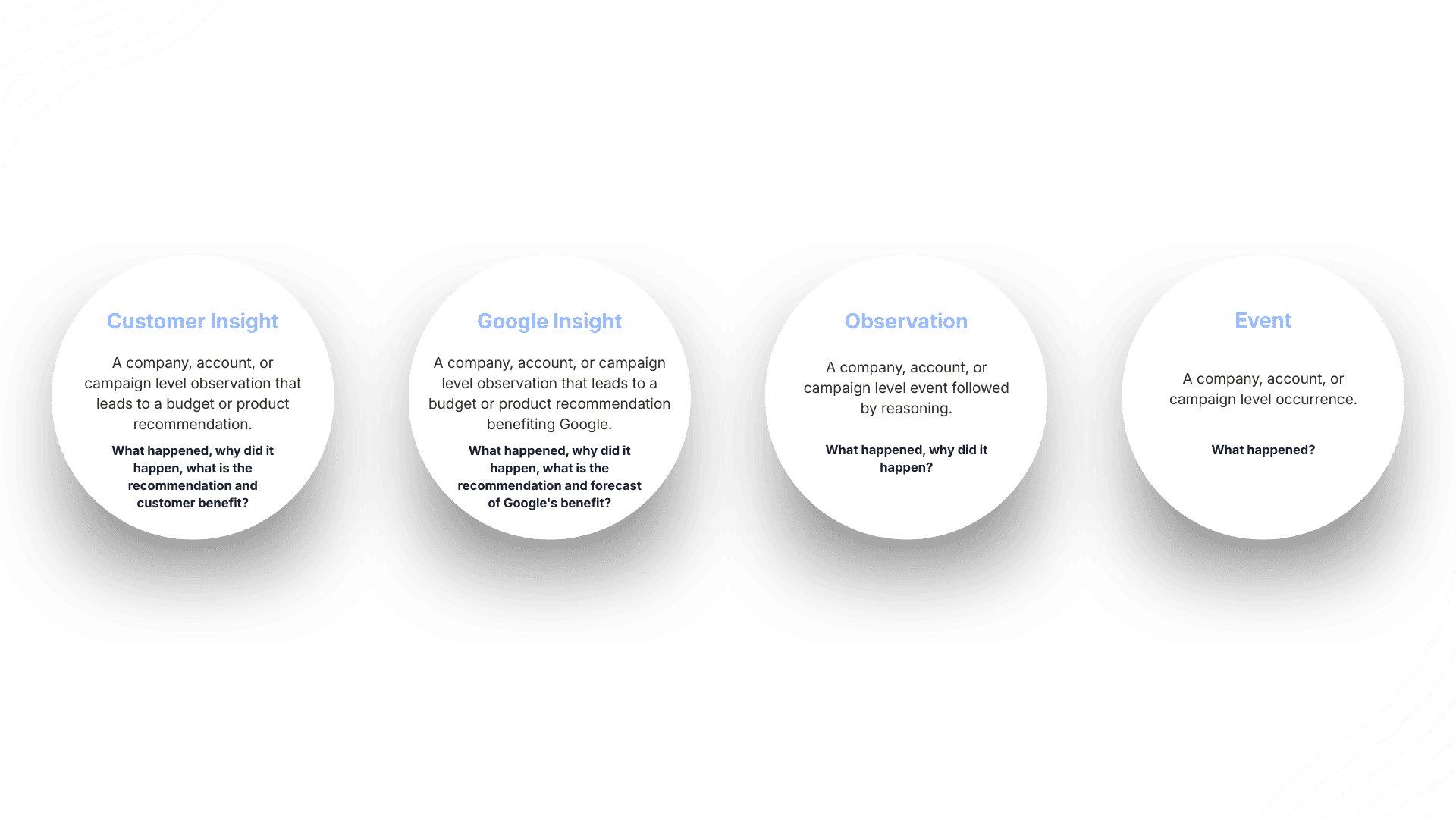
I introduced a simple, durable categorization model grounded in how value is created.
Primary (revenue-linked):
How Google makes money
How advertisers make money
Secondary (supporting action):
Observational: actionable customer or account data
Event-based: contextual information that informed decisions
This system:
defined what qualified as an “insight”
reduced noise without removing information
allowed sellers—not the system—to determine relevance
gave teams a shared framework for future work
Outcome :
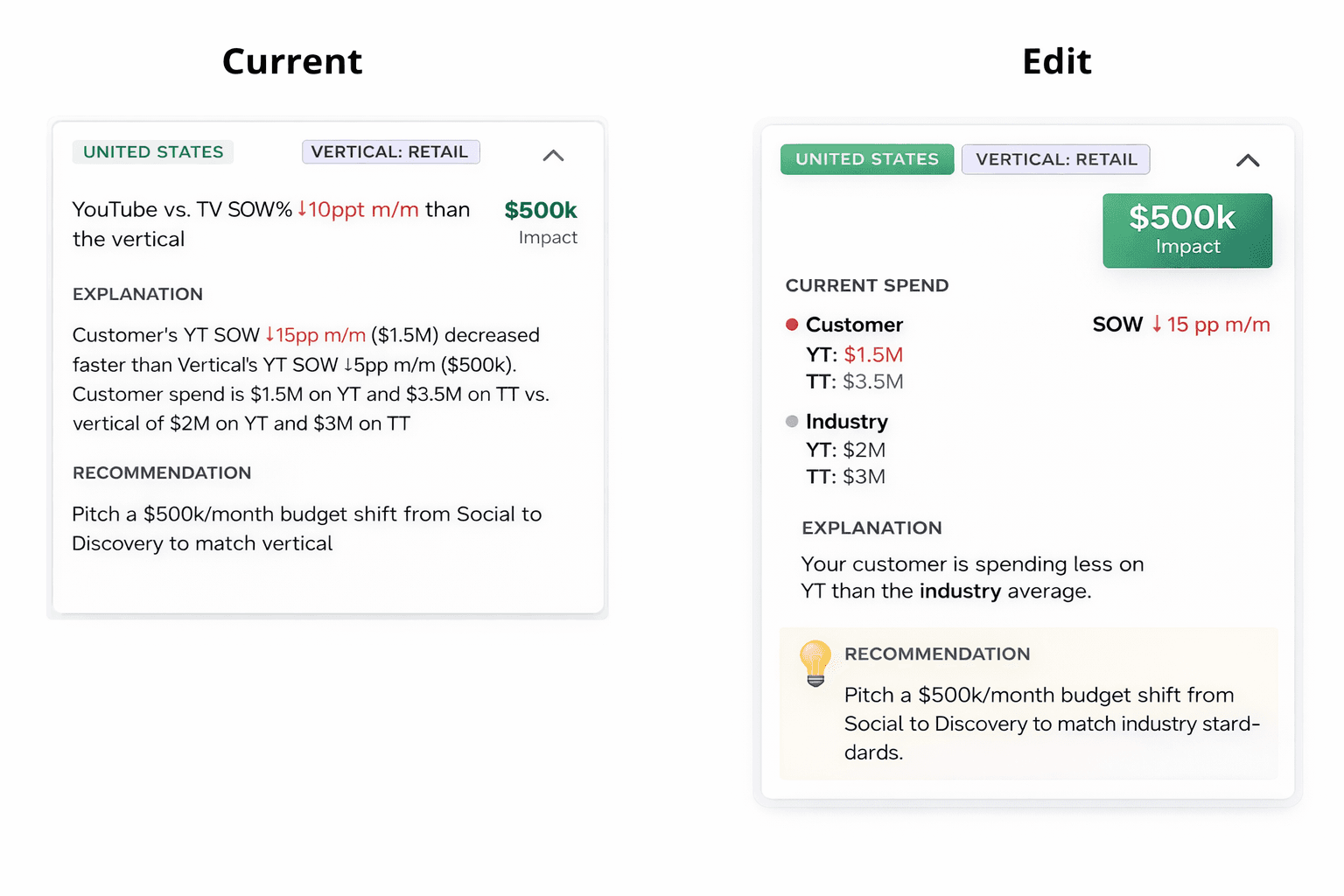
Sellers could quickly understand why an insight existed and how to act
Content became clearer and more accessible to new and experienced sellers
Cognitive overload decreased while speed to action improved
Teams shipped insights that fit into a coherent ecosystem
This work shifted the platform from shipping information to delivering meaning at scale.
More Projects




Content strategy
Content Systems Thinking
Scope:
Sales Enablement CRM Platform
Compnay:
Timeline:
2 months
Intro:The Google Sales Enablement CRM Platform is an internal product that supports Google’s ad sellers teams responsible for driving the majority of Google’s revenue. The platform is highly complex and continuously evolving, with new workflows, data models, and AI-powered tools being introduced alongside long-standing legacy systems.
Problem :
The platform relied heavily on “Insights” to deliver value to sellers—yet the term had no shared definition.
Over time:
“Insight” became an umbrella label for any type of information
20+ teams shipped insights independently, without coordination
Sellers received 50–100 insights per day, regardless of relevance
Critical signals were buried in noise
CSAT data showed sellers perceived insight quality as low
One undefined term was undermining usability, prioritization, and adoption across the platform.
Goal :
Fix the problem by turning “Insights” into a clear, scalable system:
Establish a single definition
Categorize insights by purpose and importance
Align teams on when and how insights should appear
Reduce cognitive load while increasing actionability
Approach :
My focus was on leverage instead of rewriting.
We needed:
Platform-wide audit: mapped how insights were created, categorized, and delivered across UI, notifications, email, and AI surfaces.
Cross-functional alignment: led workshops to align teams on intent, success metrics, and seller needs.
Research: studied how sellers interpreted, prioritized, and acted on insights throughout their workday.
The core driver for this rework: Sellers didn’t need more information, they needed context and prioritization.
Solution :
I introduced a simple, durable categorization model grounded in how value is created.
Primary (revenue-linked):
How Google makes money
How advertisers make money
Secondary (supporting action):
Observational: actionable customer or account data
Event-based: contextual information that informed decisions
This system:
defined what qualified as an “insight”
reduced noise without removing information
allowed sellers—not the system—to determine relevance
gave teams a shared framework for future work
Outcome :
Sellers could quickly understand why an insight existed and how to act
Content became clearer and more accessible to new and experienced sellers
Cognitive overload decreased while speed to action improved
Teams shipped insights that fit into a coherent ecosystem
This work shifted the platform from shipping information to delivering meaning at scale.
More Projects
Content strategy
Content Systems Thinking
Scope:
Sales Enablement CRM Platform
Compnay:
Timeline:
2 months
Intro:The Google Sales Enablement CRM Platform is an internal product that supports Google’s ad sellers teams responsible for driving the majority of Google’s revenue. The platform is highly complex and continuously evolving, with new workflows, data models, and AI-powered tools being introduced alongside long-standing legacy systems.
Problem :
The platform relied heavily on “Insights” to deliver value to sellers—yet the term had no shared definition.
Over time:
“Insight” became an umbrella label for any type of information
20+ teams shipped insights independently, without coordination
Sellers received 50–100 insights per day, regardless of relevance
Critical signals were buried in noise
CSAT data showed sellers perceived insight quality as low
One undefined term was undermining usability, prioritization, and adoption across the platform.
Goal :
Fix the problem by turning “Insights” into a clear, scalable system:
Establish a single definition
Categorize insights by purpose and importance
Align teams on when and how insights should appear
Reduce cognitive load while increasing actionability
Approach :
My focus was on leverage instead of rewriting.
We needed:
Platform-wide audit: mapped how insights were created, categorized, and delivered across UI, notifications, email, and AI surfaces.
Cross-functional alignment: led workshops to align teams on intent, success metrics, and seller needs.
Research: studied how sellers interpreted, prioritized, and acted on insights throughout their workday.
The core driver for this rework: Sellers didn’t need more information, they needed context and prioritization.
Solution :
I introduced a simple, durable categorization model grounded in how value is created.
Primary (revenue-linked):
How Google makes money
How advertisers make money
Secondary (supporting action):
Observational: actionable customer or account data
Event-based: contextual information that informed decisions
This system:
defined what qualified as an “insight”
reduced noise without removing information
allowed sellers—not the system—to determine relevance
gave teams a shared framework for future work
Outcome :
Sellers could quickly understand why an insight existed and how to act
Content became clearer and more accessible to new and experienced sellers
Cognitive overload decreased while speed to action improved
Teams shipped insights that fit into a coherent ecosystem
This work shifted the platform from shipping information to delivering meaning at scale.