Content strategy
A Low-Friction Offer, In A High-Trust Flow
Compnay:
Super.com
Super.com is a fintech and travel app offering cash advances, travel savings, and a paid membership (Super+). At the time, I was the sole content designer, partnering primarily with the Cash Advance and Direct Deposit teams.
Problem :
Direct Deposit struggled to gain organic adoption. While valuable to the business, it was not a clear value driver for users.
To increase signups, the Direct Deposit team introduced a monetary incentive. The Cash Advance team then asked for a quick, low-effort way to surface this offer during Cash Advance onboarding.
The risk: inserting a business-driven offer into a high-intent, high-friction flow could feel disruptive, salesy, or manipulative.
Goal :
Enabling the business incentive without interrupting user intent and incrementally increasing the likelihood of opt-in while preserving trust and momentum.
Diagnosis :
After auditing both flows, I identified a few constraints:
Both Cash Advance and Direct Deposit required identity verification and sensitive financial information
Users had already invested significant time and patience to reach the approval screen
Any added friction like a detour would feel costly
This meant the offer had to:
feel additive, not distracting
preserve the user’s linear progress
clearly signal the option without pressure

Hypothesis :
If the Direct Deposit incentive was framed as a bonus, not a diversion, it could benefit users without undermining the primary goal: getting cash quickly.
Timeline :
1 design sprint
Solution :
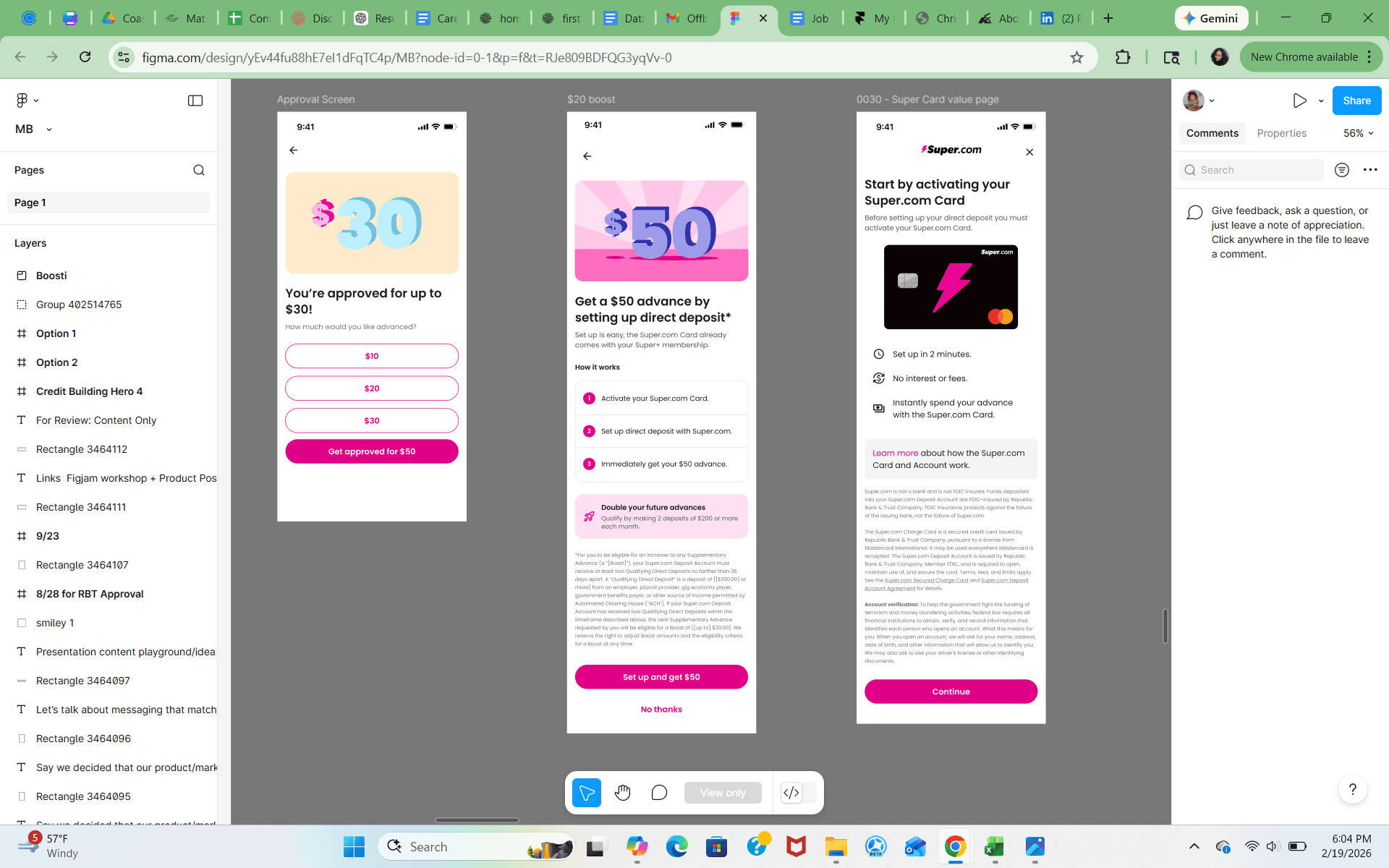
I presented two options:
an opt-in modal with the incentive
an additional button integrated into the existing flow
I recommended the secondary button because it:
was less interruptive than a modal
Had a clearer sense of optionality
maintained forward momentum
reduced the “sales-y” feeling
The button copy was intentionally distinct from the primary CTA, but persuasive enough to explain value and transparent about leading to a separate (heavier) step.
Partners :
UX Design and UX Research
Process :
The majority of the work focused on microcopy:
Being able to signal a different path without creating fear or confusion.
Setting expectations about user effort while reinforcing the same outcome.
Balancing business with user needs.
Outcome :
This design work ended up having a lasting system impact.
The secondary CTA became a UX design system pattern for scenarios where:
the business needed to promote a product users hadn’t requested
interruption carried real UX risk
This pattern was added as a safer way to introduce business-driven offers and reduce friction while respecting user intent.
More Projects



Content strategy
A Low-Friction Offer, In A High-Trust Flow
Compnay:
Super.com
Super.com is a fintech and travel app offering cash advances, travel savings, and a paid membership (Super+). At the time, I was the sole content designer, partnering primarily with the Cash Advance and Direct Deposit teams.
Problem :
Direct Deposit struggled to gain organic adoption. While valuable to the business, it was not a clear value driver for users.
To increase signups, the Direct Deposit team introduced a monetary incentive. The Cash Advance team then asked for a quick, low-effort way to surface this offer during Cash Advance onboarding.
The risk: inserting a business-driven offer into a high-intent, high-friction flow could feel disruptive, salesy, or manipulative.
Goal :
Enabling the business incentive without interrupting user intent and incrementally increasing the likelihood of opt-in while preserving trust and momentum.
Diagnosis :
After auditing both flows, I identified a few constraints:
Both Cash Advance and Direct Deposit required identity verification and sensitive financial information
Users had already invested significant time and patience to reach the approval screen
Any added friction like a detour would feel costly
This meant the offer had to:
feel additive, not distracting
preserve the user’s linear progress
clearly signal the option without pressure
Hypothesis :
If the Direct Deposit incentive was framed as a bonus, not a diversion, it could benefit users without undermining the primary goal: getting cash quickly.
Timeline :
1 design sprint
Solution :
I presented two options:
an opt-in modal with the incentive
an additional button integrated into the existing flow
I recommended the secondary button because it:
was less interruptive than a modal
Had a clearer sense of optionality
maintained forward momentum
reduced the “sales-y” feeling
The button copy was intentionally distinct from the primary CTA, but persuasive enough to explain value and transparent about leading to a separate (heavier) step.
Partners :
UX Design and UX Research
Process :
The majority of the work focused on microcopy:
Being able to signal a different path without creating fear or confusion.
Setting expectations about user effort while reinforcing the same outcome.
Balancing business with user needs.
Outcome :
This design work ended up having a lasting system impact.
The secondary CTA became a UX design system pattern for scenarios where:
the business needed to promote a product users hadn’t requested
interruption carried real UX risk
This pattern was added as a safer way to introduce business-driven offers and reduce friction while respecting user intent.
More Projects
Content strategy
A Low-Friction Offer, In A High-Trust Flow
Compnay:
Super.com
Super.com is a fintech and travel app offering cash advances, travel savings, and a paid membership (Super+). At the time, I was the sole content designer, partnering primarily with the Cash Advance and Direct Deposit teams.
Problem :
Direct Deposit struggled to gain organic adoption. While valuable to the business, it was not a clear value driver for users.
To increase signups, the Direct Deposit team introduced a monetary incentive. The Cash Advance team then asked for a quick, low-effort way to surface this offer during Cash Advance onboarding.
The risk: inserting a business-driven offer into a high-intent, high-friction flow could feel disruptive, salesy, or manipulative.
Goal :
Enabling the business incentive without interrupting user intent and incrementally increasing the likelihood of opt-in while preserving trust and momentum.
Diagnosis :
After auditing both flows, I identified a few constraints:
Both Cash Advance and Direct Deposit required identity verification and sensitive financial information
Users had already invested significant time and patience to reach the approval screen
Any added friction like a detour would feel costly
This meant the offer had to:
feel additive, not distracting
preserve the user’s linear progress
clearly signal the option without pressure
Hypothesis :
If the Direct Deposit incentive was framed as a bonus, not a diversion, it could benefit users without undermining the primary goal: getting cash quickly.
Timeline :
1 design sprint
Solution :
I presented two options:
an opt-in modal with the incentive
an additional button integrated into the existing flow
I recommended the secondary button because it:
was less interruptive than a modal
Had a clearer sense of optionality
maintained forward momentum
reduced the “sales-y” feeling
The button copy was intentionally distinct from the primary CTA, but persuasive enough to explain value and transparent about leading to a separate (heavier) step.
Partners :
UX Design and UX Research
Process :
The majority of the work focused on microcopy:
Being able to signal a different path without creating fear or confusion.
Setting expectations about user effort while reinforcing the same outcome.
Balancing business with user needs.
Outcome :
This design work ended up having a lasting system impact.
The secondary CTA became a UX design system pattern for scenarios where:
the business needed to promote a product users hadn’t requested
interruption carried real UX risk